Showing posts with label Moby Dick. Show all posts

Wednesday, December 18, 2013

Final Exam: Essay One

Essay One: The Importance of Literature in Understanding Digital Culture

Our students are best prepared for understanding the digital world around them by a traditional study of great literature. As students study quality literature, they learn how to think critically and analyze difficult texts. Their abilities to speak, write, and communicate in general are increased. These skills and others help our students to be better equipped to understand the digital world around them. However, today I will focus specifically on how studying Moby Dick by Herman Melville helps our students to understand the importance of collaboration in a digital age.

In Moby Dick, it is essential for the entire crew to work together in order to successfully hunt whales. Paul Billis, in a recent blog post, discussed a similar concept as he detailed the importance of each individual character in the text. Billis argues that Melville “craft[s] each of these characters expertly to allow each of them their own voice and personality.” Just as the Pequod cannot function without each of its crewmen performing his assigned functions, digital culture cannot function at its fullest potential without the countless men and women who actively consume and create content in a digital world.

The importance of each individual in the crew is highlighted by Starbuck’s futile attempt to convince Ahab to stop his fanatical hunt for Moby Dick. He exclaims, “O, my Captain!...Away with me! Let us fly these deadly waters!” (Melville 604). However, Ahab decides to ignore Starbuck’s counsel and continue on his hunt for the white whale, eventually leading to his death as well as the deaths of every crew member except for Ishmael. Had Ahab listened to Starbuck, the story would have had a different ending entirely. However, because Ahab ignored those around him, his quest failed and let to devastation and ruin.

As students contemplate the results of Ahab’s dismissal of Starbuck’s counsel, they learn about the importance of collaboration. When all of the crew members work together as equals, they catch whales and all is well. However, when Ahab reigns as the dictator of the ship, discounting advice from his first mate, tragedy strikes. While the results of not collaborating with others may not be as dramatic, the results are similar in that the end result is not as good as it could have otherwise been. Collaboration allows others to help us to see flaws in our work that we cannot always find on our own. As students learn about Ahab and his mad quest, they also learn about the benefits of collaboration.

This one specific example from Moby Dick shows both the benefits of collaboration and the consequences for failing to do so, which can help students to learn about this important aspect of digital culture. Classic works of literature help students to understand both collaboration and other important principles of digital culture as students think critically about such texts.

Works Cited:

Billis, Paul. "Moby Dick, Democracy, participatory Culture, and Games." Web. 18 December 2013.

Melville, Herman. Moby Dick. New York: Library of America Paperback Classics, 1983. Print.


Sunday, December 1, 2013

The Parts of a Whale in Moby Dick

I have been thinking lately about the chapters in Moby Dick devoted to each individual part of the whale. For instance, there is an entire chapter devoted to a whale's blubber. There are others focused on various other parts of its body, including its head and tale. Those chapters were particularly frustrating to me as I struggled to get through them. I would wonder, "How does learning about the skull of a whale help me to understand this story better?" Interestingly enough, as I have thought about why Melville would choose to put these chapters in his story, I have come to understand that it is important to learn about the pieces, or components, that make up a particular thing in order to understand the thing as a whole.

For example, we have been studying digital culture this semester. However, it is impossible to understand digital culture as a whole without looking at each of the little pieces that digital culture is made up of. How could I possibly begin to understand digital culture without looking at the social media aspect of it? Or if I ignored the phenomenon of the long tail? Conversely, how am I supposed to understand digital culture as a whole if I assume that it is only made up of one of these categories? That would be similar to Ishmael focusing only on the whale's tail and ignoring the rest of the massive creature.

Ishmael, as he describes the right-whale's head, explains, "As you come nearer to this great head it begins to assume different aspects, according to your point of view" (Chapter 75, Project Gutenberg electronic text). This reminds me of the process I go through every time I write a paper for class. As I look at a text through different lenses, I am able to understand it differently. Ishmael's in-depth descriptions about the parts that make up a whale show the importance of each detail of a text, no matter how trivial or difficult to distinguish from the whole it may appear at first glance.

The chapters in Moby Dick that are focused on describing different parts of a whale have reminded me of the importance at looking at the details--whether I am writing a paper for a class, learning about digital culture or other topics, or just thinking about life. Though I admit that I struggled with these chapters at first, as I followed Melville's model and looked at how that particular part fit into the story as a whole, I realized that it was teaching me to do just what I was doing-- to seek the meaning in each individual piece in order to better understand the whole.

Tuesday, November 19, 2013

Moby Dick Cetology-- Images

For my second look at Moby Dick, I decided to focus on everyone's favorite chapter-- the cetology chapter! I remember when I first read that chapter fighting the urge to go look up images of every whale mentioned. When I found out we were looking at Moby Dick through the lens of technology, I thought I would see what the benefit was of seeing images of each different type of whale.

My original plan was to link to pictures rather than copying and pasting images into the text. However, I quickly found that so many words were boring to look at. I started copying and pasting. That was more helpful in that the pictures were right in front of me. It also held my interest better.

However, I was curious to see what the effect was to get rid of all of Melville's descriptions and let the pictures actually replace the words. I found that looking at images of each type of whale is just as informative for me personally as reading Melville's descriptions. In fact, I found that seeing pictures helps me to focus a little bit better than the pages of words that all ran together in my mind. 

What is your experience as you take a look at the cetology chapter with images? Do the images change the meaning of the chapter for you?


Chapter 32: Cetology

First: According to magnitude I divide the whales into three primary
BOOKS (subdivisible into CHAPTERS), and these shall comprehend them all,
both small and large.

I. THE FOLIO WHALE; II. the OCTAVO WHALE; III. the DUODECIMO WHALE.

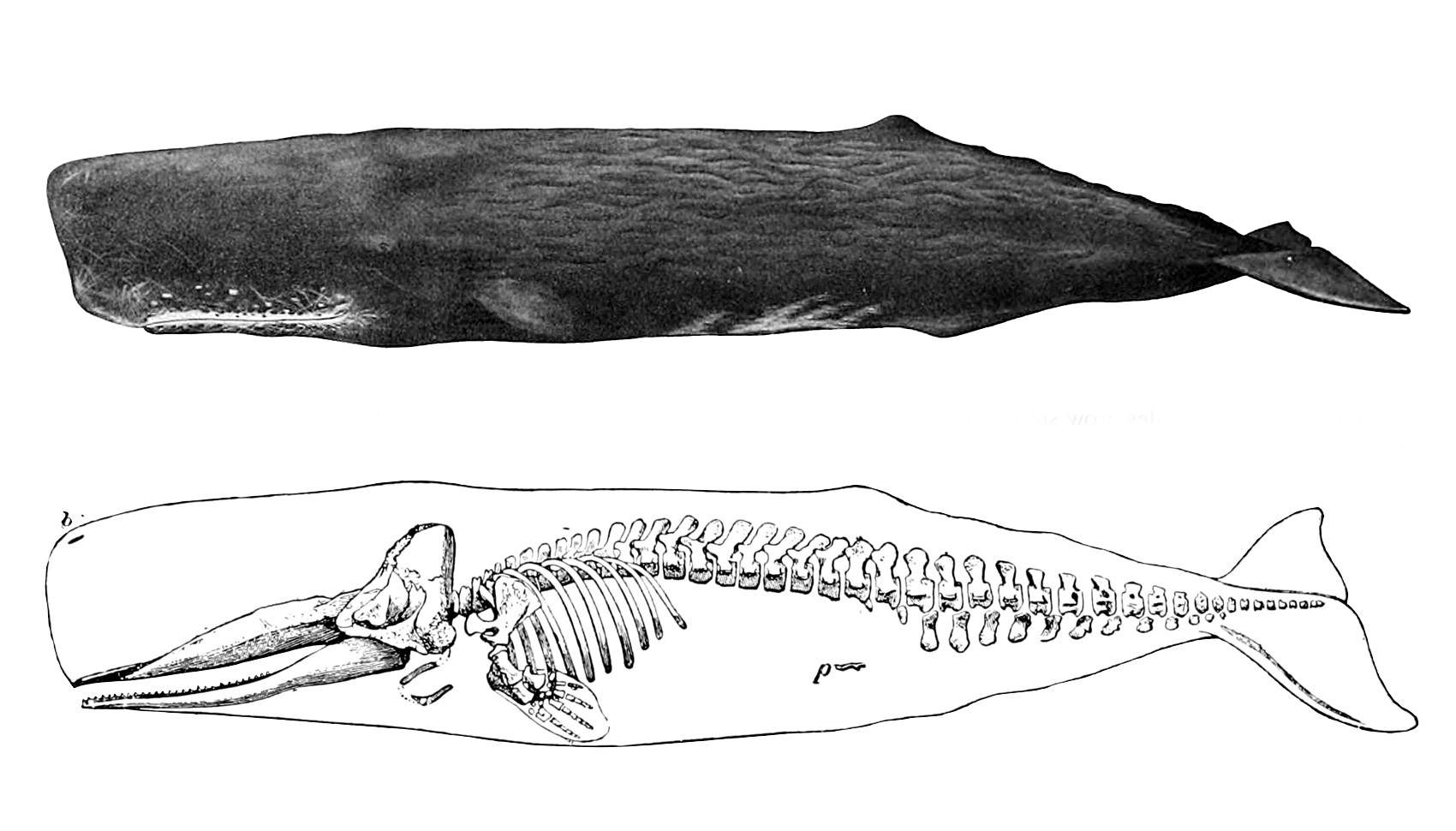
As the type of the FOLIO I present the SPERM WHALE; of the OCTAVO, the
GRAMPUS; of the DUODECIMO, the PORPOISE.

FOLIOS. Among these I here include the following chapters:--I. The SPERM
WHALE; II. the RIGHT WHALE; III. the FIN-BACK WHALE; IV. the HUMP-BACKED
WHALE; V. the RAZOR-BACK WHALE; VI. the SULPHUR-BOTTOM WHALE.

BOOK I. (FOLIO), CHAPTER I. (SPERM WHALE).
BOOK I. (FOLIO), CHAPTER II. (RIGHT WHALE).
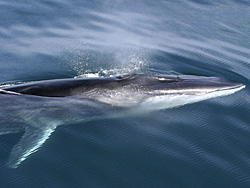
BOOK I. (FOLIO), CHAPTER III. (FIN-BACK).

File:LMazzuca Fin Whale.jpg
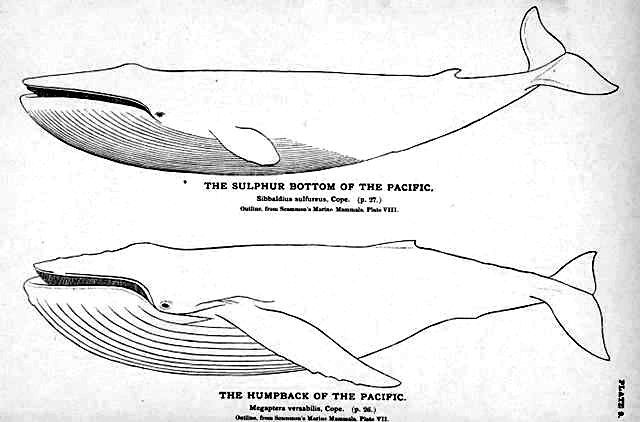
BOOK I. (FOLIO) CHAPTER IV. (HUMP-BACK).

BOOK I. (FOLIO), CHAPTER V. (RAZOR-BACK).
BOOK I. (FOLIO), CHAPTER VI. (SULPHUR-BOTTOM).
Thus ends BOOK I. (FOLIO), and now begins BOOK II. (OCTAVO).

OCTAVOES.*--These embrace the whales of middling magnitude, among which
present may be numbered:--I., the GRAMPUS; II., the BLACK FISH; III.,
the NARWHALE; IV., the THRASHER; V., the KILLER.


*Why this book of whales is not denominated the Quarto is very plain.
Because, while the whales of this order, though smaller than those of
the former order, nevertheless retain a proportionate likeness to them
in figure, yet the bookbinder's Quarto volume in its dimensioned form
does not preserve the shape of the Folio volume, but the Octavo volume
does.


BOOK II. (OCTAVO), CHAPTER I. (GRAMPUS).

BOOK II. (OCTAVO), CHAPTER II. (BLACK FISH).

BOOK II. (OCTAVO), CHAPTER III. (NARWHALE), that is, NOSTRIL
WHALE.

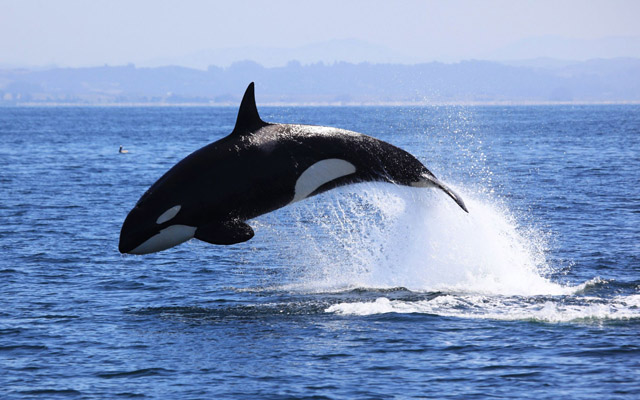
BOOK II. (OCTAVO), CHAPTER IV. (KILLER).

BOOK II. (OCTAVO), CHAPTER V. (THRASHER).

No images found.


Thus ends BOOK II. (OCTAVO), and begins BOOK III. (DUODECIMO).

DUODECIMOES.--These include the smaller whales. I. The Huzza Porpoise.
II. The Algerine Porpoise. III. The Mealy-mouthed Porpoise.

BOOK III. (DUODECIMO), CHAPTER 1. (HUZZA PORPOISE).

BOOK III. (DUODECIMO), CHAPTER II. (ALGERINE PORPOISE).--A pirate. Very
savage. He is only found, I think, in the Pacific. He is somewhat larger
than the Huzza Porpoise, but much of the same general make. Provoke him,
and he will buckle to a shark. I have lowered for him many times, but
never yet saw him captured.

BOOK III. (DUODECIMO), CHAPTER III. (MEALY-MOUTHED PORPOISE).
Beyond the DUODECIMO, this system does not proceed, inasmuch as
the Porpoise is the smallest of the whales. Above, you have all the
Leviathans of note. But there are a rabble of uncertain, fugitive,
half-fabulous whales, which, as an American whaleman, I know by
reputation, but not personally. I shall enumerate them by their
fore-castle appellations; for possibly such a list may be valuable to
future investigators, who may complete what I have here but begun. If
any of the following whales, shall hereafter be caught and marked, then
he can readily be incorporated into this System, according to his Folio,
Octavo, or Duodecimo magnitude:--The Bottle-Nose Whale; the Junk Whale;
the Pudding-Headed Whale; the Cape Whale; the Leading Whale; the Cannon
Whale; the Scragg Whale; the Coppered Whale; the Elephant Whale; the
Iceberg Whale; the Quog Whale; the Blue Whale; etc. From Icelandic,
Dutch, and old English authorities, there might be quoted other lists of
uncertain whales, blessed with all manner of uncouth names. But I omit
them as altogether obsolete; and can hardly help suspecting them for
mere sounds, full of Leviathanism, but signifying nothing.

Finally: It was stated at the outset, that this system would not be
here, and at once, perfected. You cannot but plainly see that I have
kept my word. But I now leave my cetological System standing thus
unfinished, even as the great Cathedral of Cologne was left, with the
crane still standing upon the top of the uncompleted tower. For small
erections may be finished by their first architects; grand ones, true
ones, ever leave the copestone to posterity. God keep me from ever
completing anything. This whole book is but a draught--nay, but the
draught of a draught. Oh, Time, Strength, Cash, and Patience!

(The text was taken from the Project Gutenburg electronic text)