Literature has the unique opportunity of being subject to a new style of learning in this digital age. Digital Culture presents many unique ways to interpret a once rigid and traditional area of academic. No longer is reading and writing papers necessary to communicate understanding of both ancient and modern authors. The digital concept of remixing allows students to demonstrate their understanding of key texts through new mediums.
Remixing is editing and reformatting of an existing idea and is an exciting trend occurring in all fields of the digital world, including music, videos, memes and pictures. If college English curriculums were to adopt this method of creation, students could transcend mere theoretical understanding through an applied knowledge. For instance, an English student would take a literary work of someone else's or his own and "remix" it through another means to communicate his total understanding of the original idea. This student might take Paradise Lost and create an encyclopedia of the classical allusions Milton uses or a video montage of key themes using artists' renditions of the literary scenes. Through remixing in Digital Culture, students transcend rote rehearsal of ideas and repetition in papers, and format the same ideas in a way that appeals to audiences beyond the classroom.
In practice here at BYU, we made memes, word clouds and videos of themes present in Moby Dick. This allowed us as students to narrow in on important concepts in the work and create artistic renditions that would convey our knowledge in an accessible and clear fashion. The art of remixing is constantly expanding, and if academic leaders choose to incorporate this idea into their studies, they will continue to be educated as new students present their ideas in innovative forums and styles. It benefits infinitely more people than the few an academic paper has the ability to impact. Overall, remixing, used as a creative tool in Digital Culture, can be applied to theories in learning, to positively influence and educate a greater audience than current traditional assignments.
Showing posts with label posted by Ashley. Show all posts
Showing posts with label posted by Ashley. Show all posts
Wednesday, December 18, 2013

Essay One: Moby Dick and Isolation in Digital Culture
Moby Dick reflects a multitude of themes present in Digital Culture. Primarily because of these four concepts: unique characters, new environment, a previously unknown/or misunderstood subject and relationships. I am going to focus on one of these ideas-relationships, specifically in terms of isolationism.
Within the bounds of Digital Culture, we have learned of the importance of collaboration, which Cheri will address, and how it is necessary to gather social proof and reach out to others. The very act of isolating yourself is forced denial of supporting ideas, helpful resources and a greater knowledge (Heidi is studying this in her essay). In theory, the concept of social outreach is comprehensible, but is largely neglected, in practice. Through Moby Dick's Captain Ahab, we see the dichotomy of collaboration and isolation and their respective effects.
From the beginning of the epic, Captain Ahab isolates himself from his crew. This does not inspire confidence in his comrades, and alienates him from them, and also his sole purpose-to find the great, white whale. Captain Ahab only slightly embodies the spirit of collaboration when he interacts with other ships and captains to inquire if they have seen Moby Dick. His lack of interest in their plights is not well-received and is destructive to his relationships. He even recognizes it in himself and his family, as his obsession deepens and gains control of his life and actions. Nevertheless, it is only through his collaboration with the other ships and their captains that Captain Ahab is able to track Moby Dick's whereabouts and eventually locate the whale.
Captain Ahab's example of isolation and collaboration can be echoed in Digital Culture as we create our online identities. We, as individuals, have the opportunity to build up reputations, yet if we do not interact with others, there will be no reputations. Beyond that, by isolating ourselves, we do not share our ideas, and allow them to progress, thus begging the question of why do we come up with these ideas? Captain Ahab represents one who does not care about his identity, and is thus, is disregarded or thought of as a lunatic. By creating an online presence and interacting with others, we further our own knowledge, establish credibility and ultimately, reach our full potentials.
Within the bounds of Digital Culture, we have learned of the importance of collaboration, which Cheri will address, and how it is necessary to gather social proof and reach out to others. The very act of isolating yourself is forced denial of supporting ideas, helpful resources and a greater knowledge (Heidi is studying this in her essay). In theory, the concept of social outreach is comprehensible, but is largely neglected, in practice. Through Moby Dick's Captain Ahab, we see the dichotomy of collaboration and isolation and their respective effects.
From the beginning of the epic, Captain Ahab isolates himself from his crew. This does not inspire confidence in his comrades, and alienates him from them, and also his sole purpose-to find the great, white whale. Captain Ahab only slightly embodies the spirit of collaboration when he interacts with other ships and captains to inquire if they have seen Moby Dick. His lack of interest in their plights is not well-received and is destructive to his relationships. He even recognizes it in himself and his family, as his obsession deepens and gains control of his life and actions. Nevertheless, it is only through his collaboration with the other ships and their captains that Captain Ahab is able to track Moby Dick's whereabouts and eventually locate the whale.
Captain Ahab's example of isolation and collaboration can be echoed in Digital Culture as we create our online identities. We, as individuals, have the opportunity to build up reputations, yet if we do not interact with others, there will be no reputations. Beyond that, by isolating ourselves, we do not share our ideas, and allow them to progress, thus begging the question of why do we come up with these ideas? Captain Ahab represents one who does not care about his identity, and is thus, is disregarded or thought of as a lunatic. By creating an online presence and interacting with others, we further our own knowledge, establish credibility and ultimately, reach our full potentials.
Tuesday, December 17, 2013
How I've Come to Understand Digital Culture
I do not think I will ever be a Digital Culture aficionado. That being said, I learned a lot this semester and have implemented more class material into my habits than I would have thought possible, for me, at least. Several areas of technology are still beyond my scope of understanding or interest...video games...sorry Greg, Paul and Heidi. Nonetheless, all my classmate's contributed unique and valuable ideas to the digital culture community.
Primarily, I will incorporate socially optimized research into my academic future. I really enjoyed all the resources we received regarding how to reach out to friends, professionals and strangers. For myself, I used several social media sites this semester to gather opinions from my peers (instagram, Google+, Twitter and Facebook). When writing my final paper, I found email addresses for a journalist at the Guardian and a Professor of Parenting, both of which responded to my queries! I liked being surprised with new tools the internet has to offer, such as the curating add-on's available which are so much easier to use than emailing links to myself. As for social proof, I think it makes papers more credible when there is a variety of sources and you have a personal knowledge, investment, and experience with the topic.
I personally struggle with going beyond my comfort zone and I still have that "I don't want to rely on technology too much" attitude. The course "forced" me to explore different websites, use media to explain things, read online books and share my intellectual ideas with others on a public forum. My final research paper on digital natives was more a three month journey than a one-sitting, regurgitation of a paper (which it typically is). I was able to incorporate experiences from my peers into an academic paper that I have a genuine interest in and a subject I believe is relevant and forthcoming in society. Cheri's topic of tablets with autistic children appealed to me because I wrote about technology in school and in parenting and her research literally proved the benefit of electronic devices in families and educational settings.
Overall, I feel more at ease with the digital world and what it can do for me, especially in the writing field. It is merely about traveling the long tail, on various legs of a journey.
Friday, December 13, 2013
Outreach and Paper Submission
My paper is more formal and I don't think it would be applicable to format it for a parenting blog. However, I did submit an "abstract"/proposal to Parenting.com, which is associated with Family Circle. It will be another 4-6 weeks before I hear anything though...
I was hoping to submit to a BYU magazine/journal and I've contacted both the McKay School of Education about their magazine and the Family, Home and School Sciences journal, "Connections". have yet to hear back from them about the process of submitting papers.
As a back-up, I did submit my paper to the BYU Scholars Archive. So it is in the public records for a small percentage of academics to glean from!
I was hoping to submit to a BYU magazine/journal and I've contacted both the McKay School of Education about their magazine and the Family, Home and School Sciences journal, "Connections". have yet to hear back from them about the process of submitting papers.
As a back-up, I did submit my paper to the BYU Scholars Archive. So it is in the public records for a small percentage of academics to glean from!
Wednesday, December 11, 2013
Digital Natives Raising Digital Natives
Here's the link to my final paper: https://docs.google.com/document/d/1id9Eef8WcF4KEJj4yrM5FYWuB52uyWR4bVKQ87KcpHk/edit?usp=sharing
Sorry if the formatting is not right, it seemed to change some things when I pasted from the Word document.
Sorry if the formatting is not right, it seemed to change some things when I pasted from the Word document.
Tuesday, October 22, 2013
Life as a Digital Native and How the Internet Will Affect Our Children
1. Social Media: I announced my intentions to read Born Digital: Understanding the First Generation of Digital Natives by John Palfrey and Urs Gasser (shortened to Born Digital in this post) on Google Plus and Twitter! No responses as of yet, but I'll update as they come.
 2. Why I Am Reading This: I originally perused our list of book options with the mindset to find a work centered around digital identity or "slacktivism". However, when I saw this title, Born Digital: Understanding the First Generation of Digital Natives, I thought that this would be extremely useful to me in the future. It is a topic relevant to my life and something I would prefer to have a general knowledge of before I embark on the path to parenthood in the far future. My primary goal is to educate myself on how to prepare to raise a family in our digital culture, but I will need to find an academic focus-perhaps digital nativity.
3. Book Preview: My initial thoughts when looking at the book (love that it's in BYU's ebrary) is that many chapters are titled after an identity: "activists," "aggressors," and "pirates," for instance and the others are rather blunt and technical. I perused the book and have come to the conclusion that this not so much a parenting book, but more of a way to express the many capacities of the internet and the digital world. The authors are extremely credible and even include a link to their website in the last chapter of the book (how often does that happen?).
4. Early Social Proof: Sadly, from the time I started this post to now, I still do not have anyone interested into my reading adventure. However, I asked my husband Cory and our friend Sean, whether they had rules about video games and internet growing up. Their families both had computers located in open, visible areas and their moms had to know their passwords. Cory was only allowed to play video games at first on weekends, and later, after they played outside and it was dark. My parents never gave me rules regarding technology or internet safety. They also had the computer in our study, facing away from the door-something I would probably not do as a parent now.
5. My Book's Friends: First, the book most frequently bought with Born Digital is The Shallows: What the Internet is Doing to Our Brains Nicholas Carr. Intriguing title and is essentially a neurological study on how surfing the web affects our brains, in comparison to reading a book. Don Tapscott's Grown Up Digital is also recommended and it too, is a study of how growing up with the internet affects brain functioning, amongst other things. He was involved in a 4.5 million dollar study of people born from 1978-1994 and how digital culture impacts their lives. It seems as though many people are interested in the biological and physical consequences of the internet.
6. Who Cares?: Both authors are director/fellow at the Berkman Center for Internet and Society at Harvard Law School, and have a large following of academics. Palfrey is also a frequent commentator on various news networks. When I did a #BornDigital search of Google and Twitter, I was surprised to see its existence and popularity because of a Yahoo! series devoted to the college class of 2017 and their adventures. The series includes guest posters like professors, videos of students' lives and all types of digital media submissions.
 7. Formal Reviews: I like this review (http://techliberation.com/2008/10/10/book-review-palfrey-gassers-born-digital/). Sorry, it won't let me hyperlink it! It is From the Technology Liberation Front and I believe its author Adam Thierer did an excellent job of summarizing the book, while pointing out flaws (like lack of opinion-too much unbias). I appreciate that they include a PODCAST discussion with John Palfrey! Listen here (http://techliberation.com/2009/02/09/tpw-41-book-corner-featuring-john-palfrey-author-of-born-digital/) It's still not allowing me to hyperlink these...
8. Informal Reviews: I was looking through Amazon reviews and found a familiar name, Adam Thierer-our author of the review at Technology Liberation Front. He gave the book 4 out of 5 stara and wrote a different, more concise review on Amazon (http://www.amazon.com/Born-Digital-Understanding-Generation-Natives/product-reviews/0465018564/ref=cm_cr_pr_top_link_2?ie=UTF8&pageNumber=2&showViewpoints=0&sortBy=byRankDescending). Overall, the book received 3 out of 5 stars but most of the reviews are positive.
9. Courses:
10. Digital Media:

3. Book Preview: My initial thoughts when looking at the book (love that it's in BYU's ebrary) is that many chapters are titled after an identity: "activists," "aggressors," and "pirates," for instance and the others are rather blunt and technical. I perused the book and have come to the conclusion that this not so much a parenting book, but more of a way to express the many capacities of the internet and the digital world. The authors are extremely credible and even include a link to their website in the last chapter of the book (how often does that happen?).
4. Early Social Proof: Sadly, from the time I started this post to now, I still do not have anyone interested into my reading adventure. However, I asked my husband Cory and our friend Sean, whether they had rules about video games and internet growing up. Their families both had computers located in open, visible areas and their moms had to know their passwords. Cory was only allowed to play video games at first on weekends, and later, after they played outside and it was dark. My parents never gave me rules regarding technology or internet safety. They also had the computer in our study, facing away from the door-something I would probably not do as a parent now.
5. My Book's Friends: First, the book most frequently bought with Born Digital is The Shallows: What the Internet is Doing to Our Brains Nicholas Carr. Intriguing title and is essentially a neurological study on how surfing the web affects our brains, in comparison to reading a book. Don Tapscott's Grown Up Digital is also recommended and it too, is a study of how growing up with the internet affects brain functioning, amongst other things. He was involved in a 4.5 million dollar study of people born from 1978-1994 and how digital culture impacts their lives. It seems as though many people are interested in the biological and physical consequences of the internet.
6. Who Cares?: Both authors are director/fellow at the Berkman Center for Internet and Society at Harvard Law School, and have a large following of academics. Palfrey is also a frequent commentator on various news networks. When I did a #BornDigital search of Google and Twitter, I was surprised to see its existence and popularity because of a Yahoo! series devoted to the college class of 2017 and their adventures. The series includes guest posters like professors, videos of students' lives and all types of digital media submissions.

8. Informal Reviews: I was looking through Amazon reviews and found a familiar name, Adam Thierer-our author of the review at Technology Liberation Front. He gave the book 4 out of 5 stara and wrote a different, more concise review on Amazon (http://www.amazon.com/Born-Digital-Understanding-Generation-Natives/product-reviews/0465018564/ref=cm_cr_pr_top_link_2?ie=UTF8&pageNumber=2&showViewpoints=0&sortBy=byRankDescending). Overall, the book received 3 out of 5 stars but most of the reviews are positive.
9. Courses:
10. Digital Media:
Sunday, October 6, 2013
Pre-Writing
I know you're all going to be like, "Ashley, don't you know any other digital culture topics besides 'identity'?" And I'd say, "Of course! I take great notes in class." I just really like this subject because it's so applicable and relevant in that it helps understand characters and people.
Here's my idea for my paper: Captain Ahab as Moby Dick-We are Defined by our Weaknesses
MOBY DICK
"Towards thee I roll, thou all-destroying but unconquering whale; to the last I grapple with thee; from hell’s heart I stab at thee; for hate’s sake I spit my last breath at thee. Sink all coffins and all hearses to one common pool! and since neither can be mine, let me then tow to pieces, while still chasing thee, though tied to thee, thou damned whale! Thus, I give up the spear!" (Chapter 135)
DIGITAL CULTURE
-Catfishing an article on fake profiles used to trick people into romances
-Fake Online Personality Motives
I'd appreciate any ideas you have relating to this proposal and whether you think I can successfully argue it!
Here's my idea for my paper: Captain Ahab as Moby Dick-We are Defined by our Weaknesses
MOBY DICK
- Captain Ahab's leg is destroyed by Moby Dick; his artificial leg is made of sperm whale jaw bone
- He is preceded by his reputation of wanting to kill Moby Dick
- He has the opportunity to "recreate" himself on every voyage with strange sailors, but chooses to be defined by his lust for Moby Dick
- Every action he takes is driven by motives to seek and kill Moby Dick
- The whale seems to know him and is able to always find his boat to destroy
"Towards thee I roll, thou all-destroying but unconquering whale; to the last I grapple with thee; from hell’s heart I stab at thee; for hate’s sake I spit my last breath at thee. Sink all coffins and all hearses to one common pool! and since neither can be mine, let me then tow to pieces, while still chasing thee, though tied to thee, thou damned whale! Thus, I give up the spear!" (Chapter 135)
DIGITAL CULTURE
- We are known by our online personas
- We typically create better, different or more enhanced versions of ourselves as avatars on the internet
- Why do we feel the need to portray ourselves as people we're not?
- Self-Awareness in general: Are we not fixated on our faults and weaknesses, more so than our achievements and strengths?
-Catfishing an article on fake profiles used to trick people into romances
-Fake Online Personality Motives
I'd appreciate any ideas you have relating to this proposal and whether you think I can successfully argue it!
Our Digital Identities
My Posts Thus Far:
General Conference Digital Reflection My venture into sharing General Conference through social media
The Downward Spiral of Academic Blogging as a College Student The spiral of academic blogging and adding “blogger’ to my identity
The Long Tail...in a Deck of Cards Fan paraphernalia is essentially an extension of an author’s work to continue on something they love
It's a Small World The Internet as one big DIY project and why I love it
My Digital Culture Ashley Hill’s take on Digital Culture and its presence in her life
Lover of Language The word choice Melville uses to describe whaling and philosophy
An Introductory Post About Me Introduction to Ashley Hill
A major theme in my posts is ME. Somehow I consistently insert myself and my experiences into whatever topic I am blogging about. This could be because I am still in phase one of academic blogging, exploring, and the only connection I am making is to that of my own life.
Nevertheless, this is related to “identity,” a subject we discussed in class last month. Our conversation centered mostly around sub-cultures on the internet and guilds like gamers and hackers. As evidenced by my blog posts, I am somewhat isolated in my digital culture presence, but through academic blogging, I have the opportunity to literally create an identity for myself and participate in a vast network of websites and forums.
In developing a web identity, one has infinite possibilities of who and what to become. Before a person can become too invested in a digital avatar, Cheri reminds us that comments provide a reality check, or a true/different perspective to the story being told. As I ponder the question of internet identity, I remember the news frenzy surrounding Manti Te'o's dead girlfriend revealed to be a con artist. How could a Heisman trophy-winning football player be duped like that? The answer is unknown, but a large part is due to the heavy presence people have online. We have the opportunity to invent a better version of ourselves on the internet but still we neglect to filter others through the rose-colored glasses in which they view themselves. I am interested in exploring whether our digital identity is merely a persona or if it should be an accurate representation of ourselves.
Do we need to be honest to our real selves when building our digital selves?
General Conference Reflection
Here are the Conference Notes Dr. Burton talked about in class. It is pretty neat to view others' interpretations of the talks and links to all the references! My husband and I looked at these a few times this weekend and I appreciate the valuable resource it will be for me in the future. I've also shared it with my family, which is a facet of Digital Culture I personally love-the ease in sharing!
.PNG)
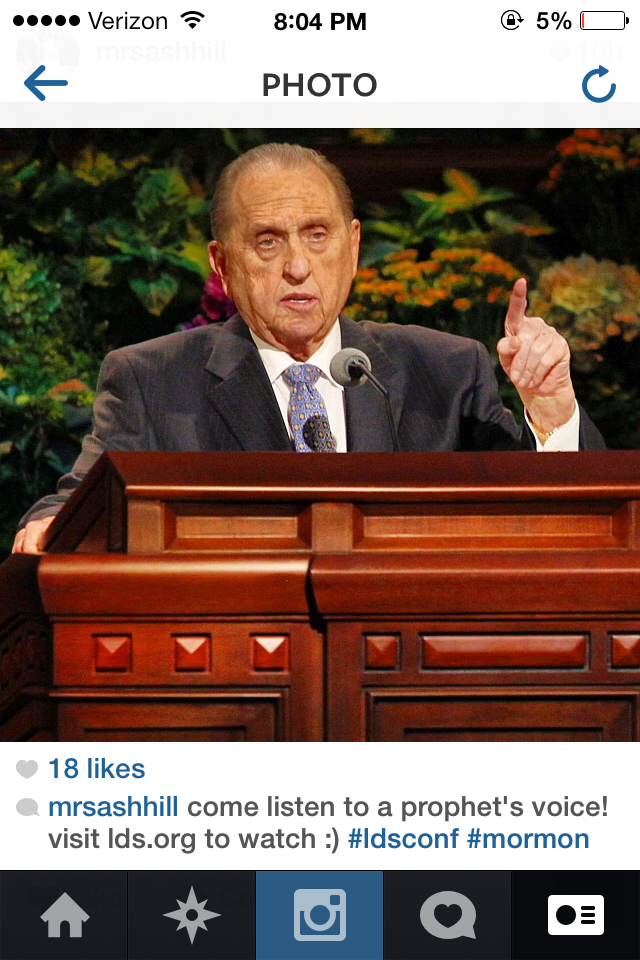
Speaking of sharing, this is the first General Conference I've used social media to invite others to listen to the words of God. I found it exciting to see who responded and if it could potentially lead to missionary work. I had several non-member friends like my Facebook statuses and Instagram posts. Only one comment though, and not of interest to learn more.


 All in all, I was one hashtag in millions, but I think I made a presence in my sphere of influence. It is overwhelming to think of how many ways we can extend our thoughts to others, but I encourage everyone to share something with your friends this week-religious or not!
.PNG)
 |
| These screenshots capture different Twitter trends at very times. My husband was following #ldsconf and found it refreshing at 18 tweets per five or so seconds. |
Speaking of sharing, this is the first General Conference I've used social media to invite others to listen to the words of God. I found it exciting to see who responded and if it could potentially lead to missionary work. I had several non-member friends like my Facebook statuses and Instagram posts. Only one comment though, and not of interest to learn more.


Regardless, it was easy for me to share my beliefs via quotes, links and pictures to my 600 or so friends/followers. One of my Facebook statuses was even "shared" by another friend which means that it had an even greater outreach. Hashtags also enabled me to connect with strangers, as we bonded over "#conferencewaffles".

Tuesday, October 1, 2013
The Downward Spiral of Academic Blogging as a College Student
For reference, these are my sources: Dr. Burton's post on the Spiral and his post on Academic Blogging
As a college student, I have many identities. For instance, I am a wife, a Sunday School teacher, a pet owner, a secretary, writer, a chef/domestic slave amongst other roles I adopt daily. "Blogger" is new to the list, and now add the adjective "Academic" to Blogger. Dr. Burton's three phases of academic blogging, Exploration, Development and Launch, are the equivalent of a Wiki how-to but for a (perhaps) more specialized audience. Clearly, I am still in phase one of Exploration. I love my iPhone, but that's about as technological as I get and the habit of sharing my thoughts virtually on a regular basis is new (and difficult) for me. Nevertheless, the topic of digital culture and academic blogging is extremely relevant in our time. As I look for jobs, it is not enough to have experience with MS Word...instead companies are looking for skills in Wordpress and other social media platforms. Imagine being able to showcase several of your highly intellectual blog posts, reviewed by members of other academic circles.
In the paragraph about Development, I was most impacted by the concept of discipline. This not only applies to blogging consistently, but maintaining discipline in what you write. Nobody's going to want to read a heavy analysis of Moby Dick if it is a paragraph of a hundred lines or random musings that are not connected by a broader theme (guilty!). Development as an academic blogger requires discipline to attract readers and commentary. Dr. Burton stated that even short posts can be "academic" as long as they are clear, concise and thorough. All the facets of discipline and development are going to be the most challenging for me, as I juggle my schedule and priorities. Inevitably, when I research a topic, I want to develop it into a full-length essay of a post which conflicts with other constraints of my identity ("Play with me!"-my chocolate lab).
Thus, the downward spiral of research, discipline, blogging...Dr. Burton used the metaphor of a spiral to represent several things, yet I interpret it as a metaphor the writing (blogging) process, which he touched on. For example, when we write, we start with a vague topic and continue downward until we narrowly define our conclusion and that's it! He suggests going back up through the spiral and analyzing all our steps on that slippery slide we so excitedly jump on when writing. Often when blogging I flesh out a topic I find interesting and then consider myself done, without fully projecting myself onto/into it. As an academic blogger, we should draw on others' ideas, but ultimately, our goal is to make each post a spark of inspiration that we personally have and if I can do that, by the end of the semester, I will hopefully be able to add "Academic Blogger" to my identity list.
As a college student, I have many identities. For instance, I am a wife, a Sunday School teacher, a pet owner, a secretary, writer, a chef/domestic slave amongst other roles I adopt daily. "Blogger" is new to the list, and now add the adjective "Academic" to Blogger. Dr. Burton's three phases of academic blogging, Exploration, Development and Launch, are the equivalent of a Wiki how-to but for a (perhaps) more specialized audience. Clearly, I am still in phase one of Exploration. I love my iPhone, but that's about as technological as I get and the habit of sharing my thoughts virtually on a regular basis is new (and difficult) for me. Nevertheless, the topic of digital culture and academic blogging is extremely relevant in our time. As I look for jobs, it is not enough to have experience with MS Word...instead companies are looking for skills in Wordpress and other social media platforms. Imagine being able to showcase several of your highly intellectual blog posts, reviewed by members of other academic circles.
In the paragraph about Development, I was most impacted by the concept of discipline. This not only applies to blogging consistently, but maintaining discipline in what you write. Nobody's going to want to read a heavy analysis of Moby Dick if it is a paragraph of a hundred lines or random musings that are not connected by a broader theme (guilty!). Development as an academic blogger requires discipline to attract readers and commentary. Dr. Burton stated that even short posts can be "academic" as long as they are clear, concise and thorough. All the facets of discipline and development are going to be the most challenging for me, as I juggle my schedule and priorities. Inevitably, when I research a topic, I want to develop it into a full-length essay of a post which conflicts with other constraints of my identity ("Play with me!"-my chocolate lab).
Thus, the downward spiral of research, discipline, blogging...Dr. Burton used the metaphor of a spiral to represent several things, yet I interpret it as a metaphor the writing (blogging) process, which he touched on. For example, when we write, we start with a vague topic and continue downward until we narrowly define our conclusion and that's it! He suggests going back up through the spiral and analyzing all our steps on that slippery slide we so excitedly jump on when writing. Often when blogging I flesh out a topic I find interesting and then consider myself done, without fully projecting myself onto/into it. As an academic blogger, we should draw on others' ideas, but ultimately, our goal is to make each post a spark of inspiration that we personally have and if I can do that, by the end of the semester, I will hopefully be able to add "Academic Blogger" to my identity list.
Monday, September 30, 2013
the long tail...in a deck of cards
i must say, i was surprised by the ending of moby dick. i was prepared for some of what happened, but not all the events. i did appreciate the symbolism, how melville weaved a tale that was entirely connected, even if it did take a hundred chapters to get there :)
anyway, i was trying to employ the concept of the long tail and searching for moby dick related articles and things, when i came across this kickstarter project.. i thought that it combined the best of digital culture and moby dick. essentially, it is a a card game that allows one to relive the adventures on the pequod via different sailors and events. the images on the cards are really beautiful. and this project was funded!
what does this mean? i think it shows that no matter what the item is, there is always a market for it. it is just a matter of finding your market. like the wired article we read last week, people are often given a minute selection of books or music or movies, when really, they would read, listen or watch hundreds of thousands more than what is offered like on amazon or netflix. kickstarter allows people to propose new ideas and if enough people support it, then it can be created. imagine how the world would be if we could do this with everything-politics, entertainment, education.
have you found any cool moby dick paraphernalia? if you could create something based on a book, which book would you choose? i would probably do something children-related with ella enchanted because i loved that book dearly growing up. how does branching out beyond the work help others to understand the novels or themes? i think people manufacture games or clothes because they truly love the novels they're reading and it is a physical manifestation of their love and presents the opportunity for discussion.
anyway, i was trying to employ the concept of the long tail and searching for moby dick related articles and things, when i came across this kickstarter project.. i thought that it combined the best of digital culture and moby dick. essentially, it is a a card game that allows one to relive the adventures on the pequod via different sailors and events. the images on the cards are really beautiful. and this project was funded!
what does this mean? i think it shows that no matter what the item is, there is always a market for it. it is just a matter of finding your market. like the wired article we read last week, people are often given a minute selection of books or music or movies, when really, they would read, listen or watch hundreds of thousands more than what is offered like on amazon or netflix. kickstarter allows people to propose new ideas and if enough people support it, then it can be created. imagine how the world would be if we could do this with everything-politics, entertainment, education.
have you found any cool moby dick paraphernalia? if you could create something based on a book, which book would you choose? i would probably do something children-related with ella enchanted because i loved that book dearly growing up. how does branching out beyond the work help others to understand the novels or themes? i think people manufacture games or clothes because they truly love the novels they're reading and it is a physical manifestation of their love and presents the opportunity for discussion.
Sunday, September 22, 2013
it's a small world
wednesday's class really struck me as well, heidi...i especially loved the virtual choir video and mentioned it to several people throughout the day. surprisingly (to me), they had already seen it! i think that says something in itself.


the idea of crowdsourcing really stuck with me because it's something we experience every day, and i highly doubt the majority of the population knows what it means. it is when an individual obtains information or ideas for a specific project or task by employing others (unpaid or not), especially via the internet. we talked about it in a variety of different ways-creative, business and academic. i was somewhat shocked to learn the hierarchy of crowd laborers (drones, commonly skilled, experts). mostly, i'm just constantly amazed at how expansive digital culture is and how much i don't know about it! even learning about websites like threadless and kompoz is a new experience for me.
i was mulling these ideas particularly this weekend as my husband and i finished a DIY project that was inspired and created via...you guessed it, crowdsourcing. cory found the idea on pinterest, a platform that allows one to pin different ideas, crafts, recipes, you name it. we then used google to look at many blogs to formulate a blueprint of what we were going to make and what supplies we would need. and thus we created our pallet headboard! none of this would be possible without the internet and the ideas of others, allowing us to design our own version of a pallet headboard.


 |
| incidentally, the pillows were inspired by pinterest too! |
when dr. burton mentioned manuals we've found online that allows us to do things ourselves, i was thinking that that is probably my favorite aspect of the internet. i love being able to look for whatever i need on the internet, which i've realized i do everyday. in fact, i can see the generational gap between my mom, grandma and i through recipes. my grandma uses only her cookbooks. my mom has tons of cookbooks, but tries to type her recipes on the computer and finds them online occasionally. and i go to various blogs or google to find recipes every day. now, i'm not exactly collaborating with anyone when i look for recipes, but i do find them from other people and post them on my personal blog (with sources). and pinterest, i think, is a whole community devoted to making the world a more beautiful and delicious place. do any of you experience crowdsourcing on a personal, business or educational level?
Saturday, September 14, 2013
my digital culture
it is interesting for me to analyze my own digital presence as we talk in class about consuming, creating and connecting. this class is already pushing me to consume, create and connect more on the internet than i do. i am also recognizing my own habits, misuses and under-utilization of the world wide web.


consume-i'm not a very good consumer in that i don't explore what digital culture has to offer. i am the one who is always the latecomer to new social media, who won't update their facebook to the newest version until it's forced on me, and who never downloads new apps on her phone. i consume a lot of digital media, meaning i constantly have my iphone in my hand, but i NEVER get sucked into youtube-watching marathons and i spend more time looking for something to view on netflix than actually watching it. already in this class, i've had to watch various videos and check out many different websites. in our milton class, we are listening to paradise lost via audible and reading milton on kindles.
create-i have a personal blog, which i update once every month or few months. my goal was to journal all the fun things my husband and i do because i don't keep a written journal (bad, i know). after talking about subcultures, i realize i have the chance to create new identities, memes, websites, videos, rants...whatever i want! this is pertinent to me because my husband and i are looking for jobs and he has been especially diligent in building up his linkedin profile and you know what? he has already had multiple companies contact him and ask for interviews, just because he has fidgeted with an online business profile for himself (for the record, he just texted me as i wrote that to tell me he has 321 connections...).

connect-this is my favorite use of digital culture because the internet does wonders at allowing people to connect! cory and i facetime our grandparents and parents every sunday...aside from family group texts and emails. i have a twitter, instagram, facebook, pinterest and now google+! those are the apps that i check most regularly and allow me to stay in touch with friends and family. as weird as this sounds, i don't think i'd be married to my husband without digital culture because the first four months we seriously dated, we were in separate states. instead we had facetime, skype, text, phone, email, facebook, twitter and voxer (a walkie talkie app) that allowed us to always be in communication.

i would be intrigued to see how digital culture has affected relationships. my great-grandmother (106 years old) spent a summer apart from her husband (then-boyfriend) and they got to talk on the phone once or twice and wrote letters to each other. another thing i am looking forward to learning about is the effect digital culture has on various generations. i know my mom always complained to me about my phone, but now that she has an iphone and an ipad and a laptop she is both gratified and appalled at what she can do. she is currently addicted to houzz. do you guys have a particularly small or large digital presence? i am looking to make mine look more professional, i guess. i've enjoyed all your posts so far-i too, had an embarrassing first email address/screen name (littlepinkalien2). and heidi, i thought the video was a little outdated. our class should make a newer version incorporating some of your suggestions!
Monday, September 9, 2013
lover of language
i knew this book was going to be long, and even our professors warned us that most of the action happens at the end of the work. and albeit, nothing truly dramatic happened, i was impressed by melville's use of metaphor, diction and imagery. from what i understand of his life, he was never really successful as an author. he had a relatively normal life, traipsing around eastern america. thus, i was pleased by the lack of cliches and multitude of clever musings.
several of my favorites include:
page 2-"Inlanders all, they come from lanes and alleys, streets and avenues--north, east, south, and west. Yet here they all unite. Tell me, does the magnetic virtue of the needles of thecompasses of all those ships attract them thither?"
what a beautiful thought that humans have this magnetic pull to the compasses on the ships, an ingrained wanderlust. this is especially applicable as ishmael writes his own antidote to depression is to travel the seas.
page 29-"In summer time, the town is sweet to see; full of fine maples--long avenues of green and gold. And in August, high in the air the beautiful and bountiful horse-chestnuts, candleabra-wise, proffer the passer-by their tapering upright cones of congregated blossoms."
i love the metaphor of the trees as chandeliers, "tapering". i think i can read 130 chapters of writing like this!
page 75-"With a prodigious noise the door flew open, and the knob slamming against the wall, sent the plaster to the ceiling; and there, good heavens! there sat Queequeg, altogether cool and self-collected..."
now this little anecdote isn't brimming with literary devices, but it is vivid and creates a perfect image in one's mind of ishmael's panic and queequeg's unperturbed self-meditation. i think it also describes their relationship, as queequeg seems experienced and unbothered whereas ishamel is still nervous and somewhat submissive.
several of my favorites include:
page 2-"Inlanders all, they come from lanes and alleys, streets and avenues--north, east, south, and west. Yet here they all unite. Tell me, does the magnetic virtue of the needles of thecompasses of all those ships attract them thither?"
what a beautiful thought that humans have this magnetic pull to the compasses on the ships, an ingrained wanderlust. this is especially applicable as ishmael writes his own antidote to depression is to travel the seas.
page 29-"In summer time, the town is sweet to see; full of fine maples--long avenues of green and gold. And in August, high in the air the beautiful and bountiful horse-chestnuts, candleabra-wise, proffer the passer-by their tapering upright cones of congregated blossoms."
i love the metaphor of the trees as chandeliers, "tapering". i think i can read 130 chapters of writing like this!
page 75-"With a prodigious noise the door flew open, and the knob slamming against the wall, sent the plaster to the ceiling; and there, good heavens! there sat Queequeg, altogether cool and self-collected..."
now this little anecdote isn't brimming with literary devices, but it is vivid and creates a perfect image in one's mind of ishmael's panic and queequeg's unperturbed self-meditation. i think it also describes their relationship, as queequeg seems experienced and unbothered whereas ishamel is still nervous and somewhat submissive.
Sunday, September 8, 2013
an introductory post about me :)
happy sunday, team starbuck! i am kind of new to this whole blogging for a class thing...but i'm hoping i will be more tech-savvy by the end of the semester. a girl can dream!


i, too, am slightly intimidated about reading moby dick and sharing insightful comments on a (semi) permanent and public forum! luckily the chapters are somewhat short, or maybe that's the small font. regardless, it will be an adventure and a book we can all cross off our "famous works read" list.
a little about myself...

i'm a senior, majoring in english, minoring in communications...graduating in april 2014! i've been married for about a year and a half to cory, a lover of swimming, salmon and technology. he is almost done with school too, graduating with a degree in japanese and minor in communication disorders. we have no idea where we will end up after graduation-this fall we are applying for lots of jobs!


these are my dogs! sienna, our chocolate lab puppy, is crazy...in fact, i had to search through pictures to find one that wasn't a documentation of her doing something naughty-like chewing up rolls of toilet paper or dragging her ceramic food bowl through the dog door, effectively breaking it in half. i love her to death though. she's a little over one year old and we got her august 2012.
ella, a cocker spaniel, is nine years old and my parents' dog! they sent her on a plane about two weeks ago to our house because they are moving and couldn't handle a dog with all the traveling/packing etc. so she's the newest member of our family and is still adjusting to a new lifestyle (she doesn't get to sleep on our bed all day and eat our table scraps). it's the rough life. and yes, we have yellow suede couches.
these three creatures make up most of my life, besides school and working as a secretary at the department of visual arts! i LOVE cooking, am trying to get back into running, new girl, big bang theory and downton abbey, and going to farmers' markets/yard sales/thrifting to fund my obsessive decorating habit.
in answer to our lovely captain's questions:
1. this is probably the hardest questions for me ever! noodles & co. indonesian peanut saute. curry. sushi. pumpkin ice cream.
2. is it sad i don't have a bucket list? i've had a list of baby names i want to name my kids since i was thirteen. creepy, but true. and i want to build and decorate my own home!
3. ella enchanted was my childhood favorite book. i love pride and prejudice and louis l'amour books.
Subscribe to:
Posts (Atom)